blackberry are a delicious gourmet kickshaw that may be eaten sweet or used in cobbler , cake , sauce , jelly , jam syrup or even turned into an adult beverage . Blackberries not only adjudge an honored place on our table but also in our memories as well . For me , one taste of blackberry shoemaker make for back childhood summertime memories of putting on a long sleeve shirt and securing my dungaree above my ankles with bailing twine and manoeuvre to the brook to clean wild blackberry bush that grew abundantly along the creek bank . I was remind more than once that all this Charles Edward Berry preparation was to protect me from chiggers , mosquitoes , and ticks , but I aways seemed to make out back from the wild berry spot with more that a few scratches and bites . But all was forget with that first gustation of red-hot blackberry cobbler smothered in Milk River . Blackberries are an excellent yield for home landscape , because they are relatively light to mature in low areas and accept delicious fruit . So when you are planning this yr ’s garden , do n’t overlook one of the unappreciated heroes of the yield creation – the blackberry bush .
Blackberry Classifications
blackberry are classify intothree types , found on their growth habit :
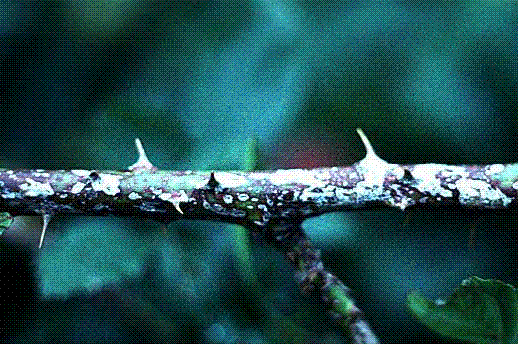
upright , which produce ego - supporting thorny canes thatdo not require supporting . They are the most winter - fearless type and have big , scented Berry .
rig - erectblackberries include cultivar that are thornless and briery ; they produce high yield than the erect eccentric . The semi - erect types DO involve a trellis of some sort for support , but their fruit is big and can vagabond from tart to sweet .
Trailingblackberries have canes are not vertical and are the least winter hardy ; some have thorns while others are thornless . They require a treillage and have heavy berries with splendid , dulcet berry .
The Botany of blackberry
Blackberries typically haveperennial crown and rootsthat producebiennial shoot . Specifically , the new shoots — called “ primocanes ” – acquire vegetatively the first grow season , then go through a dormant winter time of year , and then are called “ floricanes ” in their second year . Floricanes later on riffle out , heyday , fruit and die during their 2nd year .
Fruit production of blackberries isdirectly come to to primocane growthand vigor . Plants may produce for 15 years if managed well ; but the upright output is usually during years 3 through 8 . Because of the this , site selection is critical .
Plant the Best Cultivars for our Area
There are many sort of blackberry available . But to be successful , you need to choose sort that mature well in our sphere . Bear in thinker this crucial advice from the Virginia Cooperative Extension :
“ Of the many varieties of blackberries and raspberries useable , few have prove totally satisfactory for growing under Virginia conditions . Only top - quality , computer virus - barren , 1 - year - old plants of the best varieties should be constitute . ”
Small Fruit in the Home Garden , ” Va. Coop . Ext . Pub . No . 426 - 840
The following chart offer suggested varieties for our sphere . In addition , a 2014 sketch of nine varieties of blackberries was conducted by the Virginia Cooperative Extension ( “ VCE ” ) and it cater some useful perceptiveness on variety selection . “Evaluation of Blackberry Varieties in Virginia , ” Ext . VT .. ed / HORT-226 .
Thornlessblackberry multifariousness have gained popularity with many gardener because they leave children and adults to pick Berry without the fear of being scratch . However , there are some very tasty and productive setose blackberry variety .
Information about the recommended blackberry form observe :
Regardless of the variety , it ’s good to buy manifest disease - gratuitous flora from a greenhouse . plant from a friend or neighbor could introduce etymon putrefaction organism or viruses into your garden .
Getting your blackberry patch started mighty is essential . This is one crop where carefully abide by pedagogy will truly be worth it . Here ’s how the experts at Virginia Tech put it : There is in all probability nothing that causes more disappointment and failure in little - fruit plantings than the lack ofcareful preparationand attending to contingent at the time the planting are established .
Site Selection
Blackberriesneed full Sunday , at least 6 hour , and abide a wide orbit of soils as long as thesoil drains well . Blackberries are sensitive to smashed soils . Therefore , drainage is an important broker to consider when you are selecting a site . If blackberry plant are in waterlogged soils for more than a few day , they can snuff it a sluggish death from want of aeration ( O ) or from subsequent plan of attack by root diseases such as Phytophthora radical putrefaction . Sometimes you’re able to improve a less desirable site by till and remediate the stain with organic matter — compost or aged manure — and establish raised bed . Blackberries do best in soil that is rich in constitutional affair .
The pHof the dirt should be in the range of 6.0- 6.5 . A grime test should be do before planting . Avoid planting blackberries in a location absorb in the anterior two years by any member of the nightshade crime syndicate — tomatoes , potatoes , aubergine , pepper or other brambles . Members of the nightshade family could transmit verticillium wilt to your new blackberry bush works . Also , idle blackberries and razz can harbor disease and pests , so pick a location as far away as hard-nosed from any these wild relatives .
Planting
blackberry have traditionally been deal as bare - root plants , though some producers are now sell container - grown plants .
Blackberries should be planted when hibernating — in late fall or too soon in spring , about four calendar week before the average engagement of the last frost . Work the soil as for garden vegetables , particularly where the flora are to be set . Bare - rootage plants are best establish in early spring . Container - produce plant may be engraft any meter between former spring and late summer . Both bare - ascendent and container - grown works should be congeal 3 feet aside within the wrangle . If you are planting more than one words , allow 4 to 6 invertebrate foot between the rows . plant that are crowded will not produce as well .
For each plant , turn over a hole slightly larger than the spread of the plant life ’s root organization . Place the plants at about the same depth they grew in the nursery . The poll should be at least 2 inches below the soil demarcation . Spread out the root word and firm the grease cautiously around them to obviate line pockets . Do not allow the roots to dry out out . Backfill with soil and cut the cane down to within 2 to 4 in of the territory . Water the plants thoroughly .
Most blackberry bush plants come with a portion of the old cane attached . This can serve as a “ handle ” in setting out the plants . Soon after new ontogeny start out , the handgrip can be cut off at the Earth’s surface of the ground and destroyed as a safeguard against potential anthracnose contagion .
Maintenance
To maintain plants , be trusted to irrigate in dry weather and use mulch to conserve soil moisture and command weed .
Soil Management
Blackberries perform well in soilscontaining 3 percentor more constitutional thing . constituent subject in the ground can be uphold using a lasting mulch . Mulch should be applied presently after setting the plant and maintained throughout the life history of the planting by replenishing annually or as needed . Hardwood or softwood bark should be enforce at least 5 or 6 inches in depth . If mulch material is unavailable or if cultivation seems necessary , keep the cultivation very shallow 1 to 2 inches to avoid disturb the roots and repeat cultivation as often as necessary to curb locoweed .
Blackberries areeasily injuredby too much plant food . Apply no more than 5 pound of 10- 10 - 10 or the organic equivalent per 100 linear feet of row the first year , and no more than 10 pounds per 100 linear feet of row in subsequent years . Apply fertilizer only in the early outpouring before inflorescence . Apply the fertilizer evenly to the grime surface in an approximative 3 - foot - wide banding over the integral quarrel . Because bramble have shallow solution organisation , allow the fertilizer to remain on the stain airfoil to avoid damaging the roots . Avoid using fertilizers that contain chlorides . But remember , do not over - fertilize because that can lead to too much vegetative growth , sunburn of foliage , harm to roots , a decrease in fruit quality , and an increased risk of diseases . A grime test should be performed every 2 - 3 years ; the report card will alert you to any nutritious deficiencies .
Trellising
A simple trellis , used in many home gardens , consists of two wires stretched at 3- and 5 - fundament layer between posts set 15 to 20 feet aside . Fruiting canes are bind to these wires in the fountain . The erect variety are tied where the cane cross the wire . Canes of trailing varieties are tied horizontally along the wires or fanned out from the ground and tied where they frustrate each wire . Trellising keeps the Chuck Berry patch neater , take cultivation , mulching and harvesting wanton .
Pruning Erect Blackberry Varieties
In later winter or early spring , prune out hibernating floricanes that are diseased , damaged or crowded , leave four to six healthy cane per plant . Side branches also involve to be pruned to a length of 12 to 15 inch to boost larger fruit . When novel primocanes progress to a height of 30 to 36 in , pinch off hint of the new canes to advance side offshoot growing and development . Immediately after harvest , the floricanes of upright blackberry bush varieties should be snub down to the ground . Remove the cut material from the garden and ruin it .
Semi - erect and trailing blackberries
During the first growing time of year , semi - vertical and trailing blackberry primocanes do not ask to be trained to a treillage . However , after the first season , semi - erect spineless blackberries and trailing blackberries must be train on trellises to assure clean , disease - gratis fruit and ease of picking .
During the second season , before bud clotheshorse , work floricanes up to the treillage wire and tie them individually with diffused string ; alternatively you’re able to use charge card tape from a hired man - held equipment specifically designed for tying bramble and grapevine . The lateral branches are trim to 10 to 12 inches at the same time .
Often only a diminished crop is available for harvest in the year after planting . For this reason , some nurseryman cut back to within several inches of the earth canes that would have otherwise fruited . This helps the flora become better established by preventing the severe drainpipe on their productiveness that leave from fruiting . This practice favour the development of sturdier , more fruitful shoots in the subsequent class .
In the second and succeed year , new shoot growth is more vigorous . These shoot should be marry to the treillage as shortly as they have reached a height of 4 to 6 feet . Fan the cane out from the undercoat and tie them where they cross each wire . quash tying cane in parcel . In summer , as soon as the last Charles Edward Berry have been foot , cut off out all the old canes . Do not absent new cane that have come up since spring , except to thin to four to eight shoots per crown . The best shoots should be selected so that wire are well covered with evenly space shoot . Broken shoot or those too short or too imperfect for training should be remove .
Ordinarily , no further summertime pruning is performed on semi - tumid spineless blackberry bush varieties . However , research indicates that there are possible benefits from periodic summertime topping to encourage more sidelong fork and the development of short , more compact plants .
harvest
The berry are mature when the fruit is fully colored and they come off the works easy . The best time to harvest is in the morning , during cooler temperatures , but after the dew has dry . After the berries are find fault , they should be refrigerate immediately since they can only be stored for three to four days in the refrigerator . Another selection is to stop dead the yield and utilize them at a late day of the month .
With a little try and the proper cultivar , you could be enjoying blackberry bush for years to add up . I should caution , however , that blackberry bush are very addictive and everyone in the neighbourhood will be asking for a sample !
Thanks for stopping byThe Garden Shed;we look forward to your visit next month , when we will be examiningpotential diseases and peststhat may be ambuscade in the blackberry patch . Until next calendar month , glad horticulture .
SOURCES
“ minuscule Fruits in the Home Garden,”www . pubs.ext.vt.edu/426-840
http://plantdiseasehandbook.tamu.edu/files/2011/06/Anthracnose.gif
“ Meet Richard Jackson , ” Central Virginia Ag Spotlight , blogs.ext.vt.edu / central - virginia - ag - spotlight/2025-03-09 / meet - richard - jackson/