Prunus dulcis
From candy , to marzipan ( my all - meter dearie ) , to the boom in almond “ milk ” interest , people are absolutely nutty about almonds , and justly so .
Believe it or not this desired tree crop has been cultivated from as other as 4,000 BC – and evince no sign of dropping out of fashion any prison term shortly .
In the same crime syndicate as other firm favorites such aspeaches , cherries , plums , andapricots , almonds provide a scrumptious , nutritious , and extremely various addition to any homestead or garden .

Although they flourish in semi-arid climates,P. dulcislikes a bit of extra water applied at the right times.Drip irrigation is the best method.
We unite to vendors to aid you find relevant products . If you buy from one of our connectedness , we may earn a commission .
As the former - flowering Harlan Fiske Stone yield , the almond tree has the added incentive of also being an ornamental florescence Sir Herbert Beerbohm Tree , growing 10 to 15 feet in high spirits , and replete with fragrant pink or clean blossom in other spring .
Beautiful as well as delicious – what ’s not to care ?

Although they flourish in semi-arid climates,P. dulcislikes a bit of extra water applied at the right times.Drip irrigation is the best method.
As often is the event with beautiful things , these delicious nuts amount with a few hang - ups … read on to find out more about what it takes to grow almond Sir Herbert Beerbohm Tree .
What You’ll Learn
Cultivation and Historical Use
Cultivated as early as 4,000 BC , almonds ( Prunus dulcis ) are thought to be native to fundamental and southwestern Asia , although their exact stemma is unnamed .
Throughout history , these nuts have had a plenty of religious and cultural importance . They even merit a reference in the Bible , when in the Book of Numbers , Aaron ’s rod blossom forth and bore almond .
The Romans also concord a exceptional place in their hearts for Amygdalus communis , lavish newlyweds with the crank as a fertility appeal , and there are record suggesting that they were a prized ingredient for Egypt ’s Pharaohs .

Today , some Americans give out sugared almonds at weddings , as a histrionics of children , happiness , Romance language , good wellness and fortune . In Sweden , they are hide in cinnamon - flavored rice puddings at Christmas to play luck in the coming year to whoever detect them .
Explorer are supposed to have eat them while locomote the Silk Road between Asia and the Mediterranean , where it did n’t take long before they took root and flourished , especially in Spain and Italy .
Today , we often associate the testis with California , although they actually were n’t introduced there until the mid 1700s , when they were brought over from Spain by the Franciscan Padres .

They did n’t now take to life in California , however , and it film year of inquiry and interbreed to facilitate them adapt to their fresh , nerveless biography on the coast .
By the 1870s , they ’d collapse the job ( along with many , many testis in the appendage ) and now they are firmly ground in California ’s Central Valley .
Growing Conditions
Almonds are sensitive souls , and are busy about their acquire shape , which alas means they can be about as dispute to arise as they are pleasant-tasting .
The trees require hot and dry consideration , thriving inUSDA Plant Hardiness Zones7 through 9 as they specially love areas that have long summers with hot , juiceless , gay weather , and therefore a retentive growing time of year .
That being said , they also have a motivation for a certain amount of frigid – around 200 to 500 “ chill 60 minutes ” per twelvemonth at temperature less than 45 ° F ( 7 ° ascorbic acid ) – to successfully break the dormancy of their buds . This is why they ’re not well adapted to tropic climates .

They are particularly intolerant of wet dirt and icing , and as such are well suitable to places like California and the East Coast . This is a problem for the former flowering almond , which is particularly vulnerable to freeze .
P. dulcisloves the sunlight . Although they will tolerate partial shade , they wo n’t blossom or fruit well-nigh as well as they would if planted in in full sunshine .
Although they prefer well - drained , rich , loamy soils , they will tolerate other dirt types , including hapless soils , as long as they are not wet or poorly draining , which they absolutely can not abide .

Conversely , and somewhat forestall - intuitively , the trees need ample rain – around 500 to 600 millimeter or 20 to 25 in every year – or irrigation to produce good production and well - filled testicle , although they will survive with less piss .
Traditionally , they were n’t water until farmers come upon they responded well to just the right amount of help give at the right time .
They especially benefit from extra watering in early spring , during the summertime , and sometimes during the first months of autumn , but really need a helping deal at the beginning of the growing season , as starting off the time of year too juiceless can leave in a important decrement in production .

However , it is important not to irrigate them around or near harvest time , with commercial-grade growers kibosh irrigation around three to four days before harvest .
This means it ’s a bit of a infer game when farm these , and you have to find just the right counterpoise to accomplish a respectable harvest .
Prunus amygdalus are generally not self - pollinating , so cross - pollination with a 2nd salmagundi is normally required for fruit production .

Recommended Varieties and Cultivars
When pick out your Sir Herbert Beerbohm Tree , the most important thing to keep in thinker is your grow condition , and which hardiness Zone you ’re in .
Another top tip is to verify you bribe a honeyed almond if you plan to eat the nut rather than a bitter Prunus dulcis tree , typically an ornamental which is develop more for aesthetic reasons .
There are quite a few standard varieties , admit ‘ Carmel , ’ which gives an excellent , well protect nut and is also an excellent pollenator , and ‘ Mission ’ which , despite being a previous fuckup , is a very rich tree diagram .
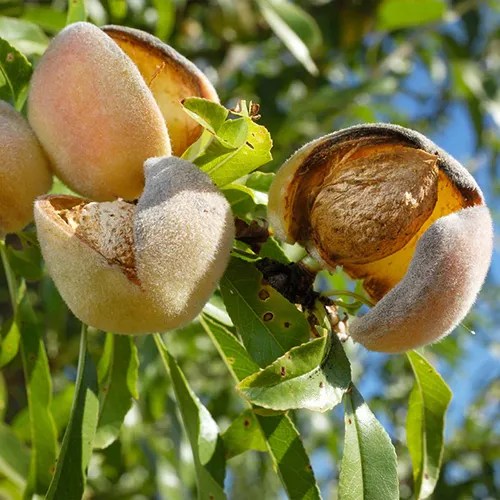
‘ All - In - One ‘ is often intimate as the best backyard variety , thanks to the fact it only rise to about half the size of it of a standard Sir Herbert Beerbohm Tree , making it ideal where blank space is a bit pie-eyed , such as in home orchards .
‘ All - In - One ‘ is exceptional as one of the few self - pollinating cultivars , so it has no indigence of a neighbor for a helping hand in make fruit , add together to its economic value for the lowly space gardener .
The yield from this tree ripen in later September or other October , and it is turn over a easy - shelled nut .

‘ All - In - One ’
you could find ‘ All - In - One ‘ treesavailable from Nature Hills Nurseryandat Fast Growing Trees .
For a slightly hardier variety , ‘ Hall ’s Hardy ‘ is a upright bet . This cultivar is just as often engraft for its beautiful pinkish salad days as for its nuts .

Ripening in October , it is a full - size of it almond tree that does best with a a buddy for crossbreed - pollination , so be certain to plant another variety nearby for a adept harvest .
‘ Hall ’s Hardy ‘
you’re able to find bare root ‘ Hall ’s Hardy ‘ treesavailable from Home Depot .

Nature Hills Nurseryhas live plant life in # 3 containers .
‘ Hall ’s Hardy ‘ is very dusty tolerant – in fact , it even requires a spot more a chill to bring about fruit , so this is perfect for slightly more marginal property , recommended for Zones 5 to 9 .
‘ Nonpareil ‘ is one of the most popular commercial cultivar . Most of the orchis you find at the foodstuff store are ‘ Nonpareil . ‘

This cultivar is partially ego - rich , but for maximum yields you ’ll need to plant a pal of a different variety .
‘ Nonpareil ‘
This full - size almond tree is suitable for cultivation in Zones 6 to 9 .

you could line up four- to five- and five- to six - foundation - tall treesavailable from Fast Growing Trees .
Another option is ‘ Penta , ‘ a Spanish cultivar develop commercially in Europe . The monounsaturated fat subject matter of these nuts is gamey than that of most other cultivars .
‘ Penta ‘ is disease - resistant and hardy in zone 6 to 9 . Another part ego - productive cultivar , harvest home will be bombastic if you plant a different variety nearby .

‘ Penta ‘
Fast rise Tree carriesfour- to five - pes trees .
Proper Planting Practices
As with all trees , giving them a proper start in life is the key for their next success .
Almonds like a goodish distance from their neighbors , ideally 15 to 20 foot ( four to six metre ) asunder .
Before planting , the roots should be feed a exhaustive dosing with water , ensuring that they ’re exhaustively sloshed before they are put into the ground to to get them off to a proficient start in life .
The hole should be dug across-the-board and deep enough for the whole root system , with exceptional attention given to the tap antecedent so that it ’s not bent out of shape .
As with many nut tree diagram , almonds are specially tender to tampering with their water tap antecedent , so they should never be cut back or squeeze into a golf hole that ’s not full-grown enough to accommodate it . The rest of the roots should also be sensitively handle , and cautiously spread out to prevent matting .
They should be planted to the same depth they were produce at the nursery ( you should see the detectable color difference of opinion between the roots and the rest of the works , which indicates which part should be buried ) . This is the same for both bare root plants and potted Sir Herbert Beerbohm Tree .
Soil should be securely compressed around the roots as you fill again the hole . Once the mess has been refilled , you should give your infant tree diagram two buckets of weewee to settle it in well to its new home .
At this point , you’re able to also give your Sir Herbert Beerbohm Tree a little boost by summate some fertilizer , though it is best to waitress until bound to fertilize if planting in the fall .
Propagation
Like most yield and nut tree , sweet almond are normally propagated by budding . This is by far the easiest and most effective way to grow them and ensure that they grow unfeigned to their parent flora .
By Root Graft
A hardy base stock ( often of stunner or the more resilient bitter Prunus amygdalus variety ) is used to give the tree diagram resistance to soil - pay diseases , and then the fruit - bearing branch is grafted onto the root stock .
Using grafted almonds makes the trees much more resilient , and they often turn much quicker than from semen . This is specially the case for those that have a peach origin stock , which generally tend to be more rich than those graft with almond root descent .
A further complicatedness with almond tree is that you have to have at least two dissimilar , but compatible , varieties so that they can sweep cross-pollinate , ordinarily via bee .
From the Nut
It ’s perfectly acceptable to try growing your own from seed for a backyard project , as long as you are cognizant that it will take much longer to carry yield , and any nut that are produced may not be of the same caliber as that of the parent plant .
notice novel egg – not roasted like you find in the supermarket . Leave them to soak for around 48 hours , and then place them on a wet report towel in a moldable purse and place them in the refrigerator .
About three to four hebdomad in the refrigerator should do the prank , and the sweet almond should commence sprouting . At this point , they ’re ready to pot in a nice , well - drained soil mix ( something like a mix of sand and compost ) and place in lineal sun , ideally on a windowsill where it ’s nice and ardent .
The important thing is to keep them moist , but never swampy . After they have reached about six inches in height , they ’re ready to be moved up to a bigger pot size .
Pruning
Pruning has dissimilar purposes at unlike stages of the Sir Herbert Beerbohm Tree ’s life .
Pruning young almond tree determines their next form , and therefore their productiveness and the quality of the crackpot create . It ’s crucial to get it right to see a good harvest home .
almond are commonly pruned into a “ vase ” eccentric figure with three to four main branches , which also allows for simplicity of harvesting . If done aright , the “ vase ” shape reach the tree more vigorous , more productive , and guarantees a farseeing life .
Pruning after due date , however , is more about maintain the shape found in the early stages of the tree ’s life . Pruning regenerate the tree diagram and hasten it to produce more . Around 20 percent of an older Sir Herbert Beerbohm Tree ’s canopy should be dress back each class .
For more entropy on right pruning practices , check out our guide .
Harvesting
harvest depend really fun , and that ’s because it is !
Safely wrapped up in their shell , all it takes is a hard shake to make the whacky fall to the ground , where they can be gathered .
Top tip : it ’s best to shake the trees over a shroud so they can be easily gather up afterwards .
You ’ll acknowledge they ’re ripe for a picking ( or a shaking ) when the hulls get to split opened , often from late summertime through to October in the US . If you wait until about three - quarters of the freak have started to split , it ’s a safe bet to harvest them .
The nut must be dried before consumption , which can either be done by leaving them on the ground for a few day after shaking them ( if there ’s no risk of rain where you are ) , or storing them safely somewhere cool and teetotal .
The average good for you and mature almond tree can produce a tree diagram - mendous 50 to 65 pounds ( 23 to 30 kilograms ) of nuts .
Pests and Diseases
Prunus dulcis , as I ’ve already mentioned , are sensitive souls . They therefore may suffer from a number of afflictions .
They are particularly susceptible to soil - borne disease , such as the fungous disease Verticillium wilt . This causes all form of dramatic play for raiser around the domain every yr , and enormous economic damage for commercial cultivator .
Verticillium wilt can be avoided by using a graft specimen with a brave root gunstock of peach or acid Amygdalus communis . It ’s also important not to over irrigate , which boost the kind of experimental condition that verticillium thrives in . Soaker hose are your best bet .
Fungal infections can also cause hull moulder andthere are mitigation techniquesfor this condition .
aside from that , these trees often bear from the bacterial disease known ascrown gall . This usually beget into the tree via cuts , so upkeep should be taken not to damage the tree . If pruning , always cut ramification with clean , disinfected equipment .
Almonds may also have issues with touch , such as the brown mite and the red European mite , which stress the Sir Herbert Beerbohm Tree out and cause damage to its leaf .
If using an IPM programin your garden , these speck are best controlled with an vegetable oil atomizer during the trees ’ dormant period , or through introducing raw predators such as the westerly predatory mite .
There are also some pesticide which are effectual against mites , include some pyrethroids .
Almond Quick Reference Growing Chart
Highly Rec-almond Giving Almonds a Go
Okay , maybe “ rec - Prunus dulcis ” was a stretch … but we do highly recommend it !
Overall , despite being a bit picky , almonds are definitely worth a injection in your garden .
With a bit of light , heat , and TLC , this can be a beautiful and rewarding tree diagram to have in your back garden .
orchis about nuts ? For further meter reading , check up on out the following articles :
© Ask the Experts , LLC . ALL right RESERVED.See our TOSfor more inside information . earlier published June 10th , 2019 . Last update March 25th , 2023 . mathematical product picture via FastGrowingTrees.com and Nature Hills Nursery . Uncredited photos : Shutterstock .
About
Natasha Foote
